

Introduction
Vitamin B12 deficiency is one of the most common yet commonly overlooked nutritional problems today, even though vitamin B12 (also called cobalamin) is one of the most important nutrients your body needs. This water-soluble vitamin plays a central role in forming red blood cells, keeping your nerves healthy, and helping your body make DNA. Unlike many other nutrients, your body cannot produce vitamin B12 on its own, which means you have to get it entirely through food or supplements — and when you don’t, vitamin B12 deficiency can quietly build up over time.
The tricky part about vitamin B12 deficiency is that it often develops slowly, over months or even years, because the liver stores several years’ worth of B12. By the time symptoms appear, the deficiency may already be moderate to severe. Left untreated, it can lead to irreversible nerve damage, so early recognition matters. Vitamin B12 deficiency is also one of the well-recognised nutritional causes of anaemia worldwide, a condition that the World Health Organization notes affects a very large share of young children and pregnant women globally. In this article, we’ll walk through the symptoms, causes, risk factors, diagnosis, treatment, and prevention of vitamin B12 deficiency, along with the best foods to eat and avoid.
Symptoms
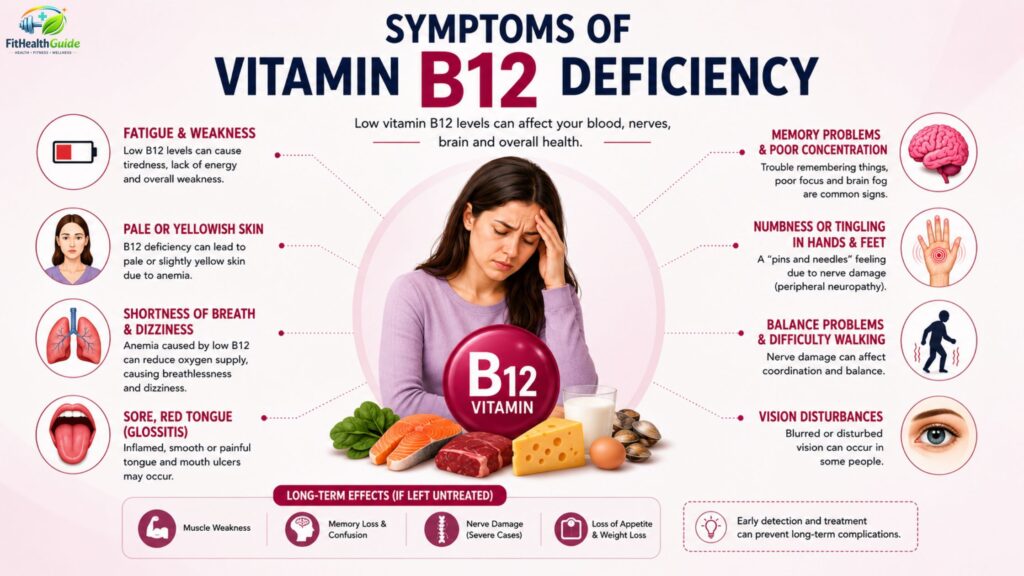
Vitamin B12 deficiency symptoms can affect the blood, the nervous system, and even mental health. They often appear gradually and can be mistaken for other conditions. Common symptoms include:
- Fatigue and weakness — one of the earliest and most common signs, caused by a reduced number of healthy red blood cells
- Pale or slightly yellow skin — due to a type of anemia called megaloblastic anemia
- Shortness of breath and dizziness, especially during physical activity
- Glossitis — a swollen, inflamed, or sore tongue, sometimes accompanied by mouth ulcers
- Numbness or tingling in the hands and feet (peripheral neuropathy)
- Difficulty walking or balance problems
- Muscle weakness
- Vision disturbances
- Mood changes, including irritability and depression
- Memory problems or difficulty concentrating, sometimes mistaken for early dementia in older adults
- Rapid heartbeat (palpitations)
- Loss of appetite and unintended weight loss
In severe or long-standing cases, neurological symptoms can become serious, including confusion, psychosis, or a condition called subacute combined degeneration of the spinal cord, which affects coordination and movement. Infants with vitamin B12 deficiency may show poor growth, low muscle tone, and delayed developmental milestones.
Causes
Vitamin B12 deficiency generally happens for one of two reasons: you’re not consuming enough of it, or your body isn’t absorbing it properly. Key causes include:
- Inadequate dietary intake — Since B12 is found almost exclusively in animal products, people following strict vegan or vegetarian diets without supplementation are at higher risk.
- Pernicious anemia — An autoimmune condition in which the body attacks stomach cells that produce intrinsic factor, a protein required to absorb B12 in the intestine.
- Atrophic gastritis — A thinning of the stomach lining that reduces stomach acid, which is needed to release B12 from food.
- Gastrointestinal surgery — Procedures such as gastric bypass or removal of parts of the stomach or intestine can significantly reduce B12 absorption.
- Digestive conditions — Disorders like Crohn’s disease or celiac disease can interfere with nutrient absorption in the small intestine.
- Certain medications — Long-term use of proton pump inhibitors (PPIs), H2 blockers, and the diabetes medication metformin can lower B12 absorption over time.
- Excessive alcohol use — Chronic alcohol consumption can impair absorption and depletion of B12 stores.
- Pancreatic insufficiency — Reduced digestive enzyme production can affect B12 release and absorption.
Risk Factors
Certain groups of people are more likely to develop vitamin B12 deficiency, including:
- Older adults — Aging reduces stomach acid production, making it harder to absorb B12 from food.
- Vegans and strict vegetarians — Plant foods naturally contain little to no B12.
- Pregnant and breastfeeding women on plant-based diets — Deficiency in the mother can affect the infant’s B12 status.
- People with autoimmune disorders — Especially those with autoimmune thyroid disease or type 1 diabetes, which are linked to pernicious anemia.
- People who’ve had weight-loss or intestinal surgery
- Individuals with chronic digestive diseases such as Crohn’s disease, celiac disease, or chronic pancreatitis
- Long-term users of acid-reducing medications or metformin
- People with heavy alcohol use
- Individuals with a family history of pernicious anemia
Diagnosis
Diagnosing vitamin B12 deficiency usually involves a combination of symptom review, blood tests, and sometimes additional testing to identify the underlying cause:
- Serum vitamin B12 test — Measures the amount of B12 circulating in the blood.
- Complete blood count (CBC) — Checks for macrocytic (enlarged) red blood cells, a hallmark of B12 deficiency anemia.
- Methylmalonic acid (MMA) and homocysteine tests — These substances build up when B12 levels are low and can help confirm a deficiency, especially when B12 levels are borderline.
- Intrinsic factor antibody test — Helps identify pernicious anemia by checking for antibodies that block intrinsic factor.
- Additional tests, such as gastric endoscopy, may be used if an underlying digestive condition is suspected.
Because symptoms overlap with other conditions like folate deficiency, thyroid disorders, or vitamin D deficiency, doctors often test for several nutrients together to reach an accurate diagnosis. In fact, fatigue and muscle weakness caused by low vitamin B12 can look almost identical to the symptoms of a vitamin D shortfall, so it’s worth getting both checked if you’re experiencing persistent tiredness.
Treatment
Treatment for vitamin B12 deficiency depends on its cause and severity, but generally includes:
- Vitamin B12 supplements — Oral tablets or sublingual (under-the-tongue) forms are often effective for dietary deficiency.
- Vitamin B12 injections — Intramuscular injections (such as cyanocobalamin or hydroxocobalamin) are commonly used for people with absorption problems, like pernicious anemia, since they bypass the digestive system entirely.
- High-dose oral supplements — In some cases, very high oral doses can be effective even without intrinsic factor, since a small percentage of B12 can be absorbed passively.
- Treating the underlying cause — This might include managing Crohn’s disease, adjusting medications, or addressing alcohol use.
- Dietary changes — Incorporating more B12-rich foods, especially important for those with mild or diet-related deficiency.
Most people notice improvement in fatigue and blood-related symptoms within a few weeks of starting treatment, though nerve-related symptoms can take longer to resolve and, if the deficiency was severe or prolonged, may not fully reverse.
Prevention
Preventing vitamin B12 deficiency largely comes down to consistent dietary intake and awareness of personal risk factors:
- Eat a varied diet that includes animal-based B12 sources, such as meat, fish, eggs, and dairy, if you’re not vegetarian or vegan
- If you follow a vegan or vegetarian diet, use B12-fortified foods or take a regular supplement
- Older adults should ask their doctor about periodic B12 screening, since absorption naturally declines with age
- If you’re on long-term medications like PPIs or metformin, discuss B12 monitoring with your healthcare provider
- Limit excessive alcohol consumption
- Pregnant and breastfeeding women, especially those on plant-based diets, should talk to their doctor about supplementation
- People who’ve had gastrointestinal surgery should follow their doctor’s recommendations for lifelong B12 monitoring or supplementation
Foods to Eat
Since vitamin B12 is found mainly in animal products, the following foods are among the best natural sources:
- Organ meats — Liver (especially beef and lamb liver) is one of the richest sources of B12
- Clams and shellfish — Extremely high in B12 per serving
- Fish — Salmon, tuna, trout, and sardines are excellent sources
- Beef and poultry — Especially lean cuts of beef and chicken
- Eggs — A good source, particularly the yolk
- Dairy products — Milk, yogurt, and cheese all provide B12
- Fortified foods — Many breakfast cereals, plant-based milks (soy, almond, oat), and nutritional yeast are fortified with B12, making them valuable options for vegetarians and vegans
- Fortified nutritional yeast — A popular vegan-friendly source often added to soups or sprinkled on meals
For people who don’t eat animal products, combining fortified foods with a B12 supplement is generally the most reliable way to meet daily needs.
Foods to Avoid
There aren’t specific foods that directly cause B12 deficiency, but certain dietary patterns and substances can make it harder for your body to absorb or maintain healthy B12 levels:
- Excessive alcohol — Heavy, regular alcohol intake can impair absorption and liver storage of B12
- Highly processed, nutrient-poor foods — A diet heavy in processed foods and low in whole foods provides little to no B12 and can crowd out nutrient-dense options
- Unfortified plant-based diets without supplementation — Strict vegan diets that don’t include fortified foods or supplements carry a real risk of deficiency over time
- Excessive caffeine or tea with meals — Some evidence suggests very high tannin intake around mealtimes may modestly interfere with nutrient absorption, though this effect is much smaller than absorption issues caused by low stomach acid or intrinsic factor deficiency
The bigger concern isn’t a specific food to avoid, but rather an imbalanced diet that lacks reliable B12 sources altogether.
FAQs
1. What is the main cause of vitamin B12 deficiency? The two most common causes are inadequate dietary intake (especially in vegans and vegetarians) and poor absorption due to conditions like pernicious anemia or reduced stomach acid.
2. Can vitamin B12 deficiency be reversed? Yes, in most cases it can be treated effectively with supplements or injections. Blood-related symptoms usually improve within weeks, though long-standing nerve damage may take longer to heal or may only partially reverse.
3. How long does it take to recover from vitamin B12 deficiency? Many people notice improvements in energy within a few weeks of starting treatment, but full recovery — especially of neurological symptoms — can take several months.
4. Can vegetarians get enough vitamin B12 without supplements? It’s difficult, since natural B12 is found almost exclusively in animal products. Vegetarians who eat eggs and dairy may get some B12, but vegans typically need fortified foods or supplements to meet their needs.
5. What happens if vitamin B12 deficiency is left untreated? Untreated deficiency can lead to permanent nerve damage, cognitive decline, severe anemia, and, in rare cases, serious neuropsychiatric symptoms.
6. Is vitamin B12 deficiency common in older adults? Yes, it’s quite common because aging reduces stomach acid production, which is necessary to release B12 from food.
7. What blood test is used to check for vitamin B12 deficiency? A serum vitamin B12 test is the standard first step, often paired with a complete blood count and, if needed, methylmalonic acid and homocysteine tests.
8. Can too much vitamin B12 be harmful? Vitamin B12 is water-soluble and generally considered safe even at high doses, as excess amounts are excreted in urine. However, you should always follow your doctor’s guidance on supplementation.
Conclusion
Vitamin B12 deficiency is a common but often under-recognized condition that can affect anyone — though older adults, vegans and vegetarians, and people with certain digestive or autoimmune conditions face higher risk. Because symptoms develop gradually and can mimic other health issues, it’s easy to miss the early warning signs like fatigue, tingling in the hands and feet, or difficulty concentrating. The good news is that vitamin B12 deficiency is highly treatable once identified — through dietary changes, supplements, or injections, depending on the underlying cause. If you suspect you might be deficient, especially if you belong to a higher-risk group, talk to your doctor about getting your B12 levels checked. Early diagnosis and treatment can prevent long-term complications and help you feel like yourself again.
This article is for informational purposes only and is not a substitute for professional medical advice. Please consult a qualified healthcare provider for diagnosis and treatment.
Related Reading: If you’re dealing with ongoing fatigue, it’s also worth ruling out other common nutrient gaps — check out our guide on Vitamin D Deficiency: Symptoms, Causes & Natural Ways to Improve Your Levels.
References
- National Institutes of Health, Office of Dietary Supplements — Vitamin B12: Fact Sheet for Health Professionals
- National Institutes of Health, Office of Dietary Supplements — Vitamin B12: Fact Sheet for Consumers
- MedlinePlus (U.S. National Library of Medicine, NIH) — Vitamin B12
- World Health Organization — Micronutrients
- Mayo Clinic — Vitamin B-12
- Cleveland Clinic — Vitamin B12 Deficiency: Symptoms, Causes & Treatment
- Cleveland Clinic — Pernicious Anemia